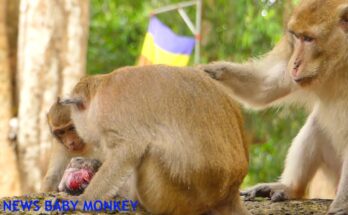
A tiny infant arrived into the dense canopy of the rainforest under a veil of vulnerability. From the moment of its birth, the newborn sat trembling in its mother’s embrace, its fragile limbs quivering against the cool morning air. The infant’s fur, damp from the birthing process, clung to its slender frame, revealing a body so slight that each breath seemed precarious. Nearby, the mother kept a vigilant watch, her eyes scanning the dappled light for any sign of danger or disturbance. Though the jungle echoed with the calls of distant parrots and the rustle of swaying branches, the infant’s faint whimper was nearly lost—its cries too soft to carry far through the verdant undergrowth.
In the hours following the birth, the infant struggled to find strength. Its mother gently guided it toward her chest, allowing the newborn to cling to her fur as she groomed it with tender licks. Each attempt at movement was tentative; the infant’s grip on its mother’s shoulder remained weak, and it often slipped, eliciting a soft murmur of concern. The mother responded by repositioning the infant, carefully supporting its head and encouraging it to nurse. With each suckle, the newborn inched closer to vitality, though fatigue continued to cloud its efforts. Observers noted that the infant appeared smaller than typical newborns of its species, prompting questions about its health and prospects for survival.
As the sun climbed higher, filtering golden rays through the leafy canopy, the infant’s condition began to stabilize. Nourished by its mother’s milk, its energy slowly returned, and its half-closed eyes brightened with burgeoning awareness. The mother, sensing improvement, offered more space on her back and allowed the infant to practice gripping with its tiny, developing fingers. Occasionally, the newborn would grip too tightly in its eagerness, causing the mother to pause and softly rebuke it before resuming her gentle ministrations. These early exercises were crucial: a secure grip would allow the infant to navigate the treetops in the coming weeks, learning to leap and cling beneath the watchful gaze of older troop members.
Despite the heartening signs of recovery, the path ahead remained fraught with challenges. Predators lurked within the underbrush, and sudden storms could reduce the canopy to a perilous corridor of swaying branches. The infant’s survival depended not only on its mother’s care but also on the support of the wider troop, which often formed protective circles around vulnerable young. Over the next several days, the troop’s dynamics would reveal whether the infant could integrate fully, receiving the necessary food and guidance to thrive. Conservationists monitoring the group emphasized that such early struggles are not uncommon in the wild, where only the strongest and most resilient reach maturity. For now, however, the story of this tiny primate remained unwritten—a testament to the delicate balance between life and adversity under the emerald roof of the jungle.