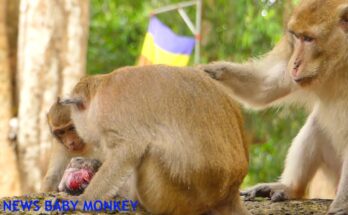
In the unpredictable world of the wild, the bond between a mother monkey and her infant is a lifeline. This connection is not just emotional but essential for the baby’s survival. When young monkeys find themselves even briefly separated from their mothers, the consequences can be terrifying. Vulnerable and visibly panicked, these tiny creatures are often met with aggression from other adult monkeys in their troop. Without the immediate protection of their mothers, they become targets—sometimes out of territorial behavior, sometimes simply due to the strict social hierarchies that dominate their groups.
The moment a baby monkey strays, even slightly, from its mother, anxiety sets in. The infant clings to its instincts, emitting sharp cries, crouching low, or frantically trying to return. These reactions, however, often attract more attention than protection. Other monkeys may perceive the baby as a threat, an intruder, or even a nuisance, especially if the troop is tense or resources are scarce. What follows can be frightening: loud vocalizations, sudden lunges, or even physical attacks. For an infant, these encounters are overwhelming, and without immediate intervention, they could result in serious injury.
Mother monkeys are highly alert and rarely allow their babies to be out of reach. However, in moments of movement—when the group is traveling or foraging—there are brief windows where the infant might slip or lag behind. Even in these short gaps, danger can arise. The young ones do not yet understand the complex social cues of the troop, nor do they possess the physical strength to defend themselves. Their vulnerability becomes apparent, and the instinct to survive kicks in, often leading to intense panic.
This distress response is a natural survival mechanism. It compels the infant to seek refuge, either by returning to its mother or by trying to appease dominant members of the group. Yet these reactions do not always succeed. Some attacks are swift and unforgiving, serving as harsh reminders of the jungle’s unforgiving nature.
Observers often feel a sense of helplessness when witnessing such scenes. The raw fear in the eyes of a baby monkey, the desperate cries, and the sudden bursts of aggression paint a vivid picture of survival in the wild. These incidents highlight the delicate balance that exists within animal communities. While they are bonded by family and kinship, they are also governed by rules that are often brutal.
Ultimately, the experiences of young monkeys in such moments underscore the importance of maternal protection and the dangers that exist when it is absent. In nature, even a few steps away from safety can mean the difference between calm and chaos. For a baby monkey, staying close is not just about love—it’s a matter of life and death.